



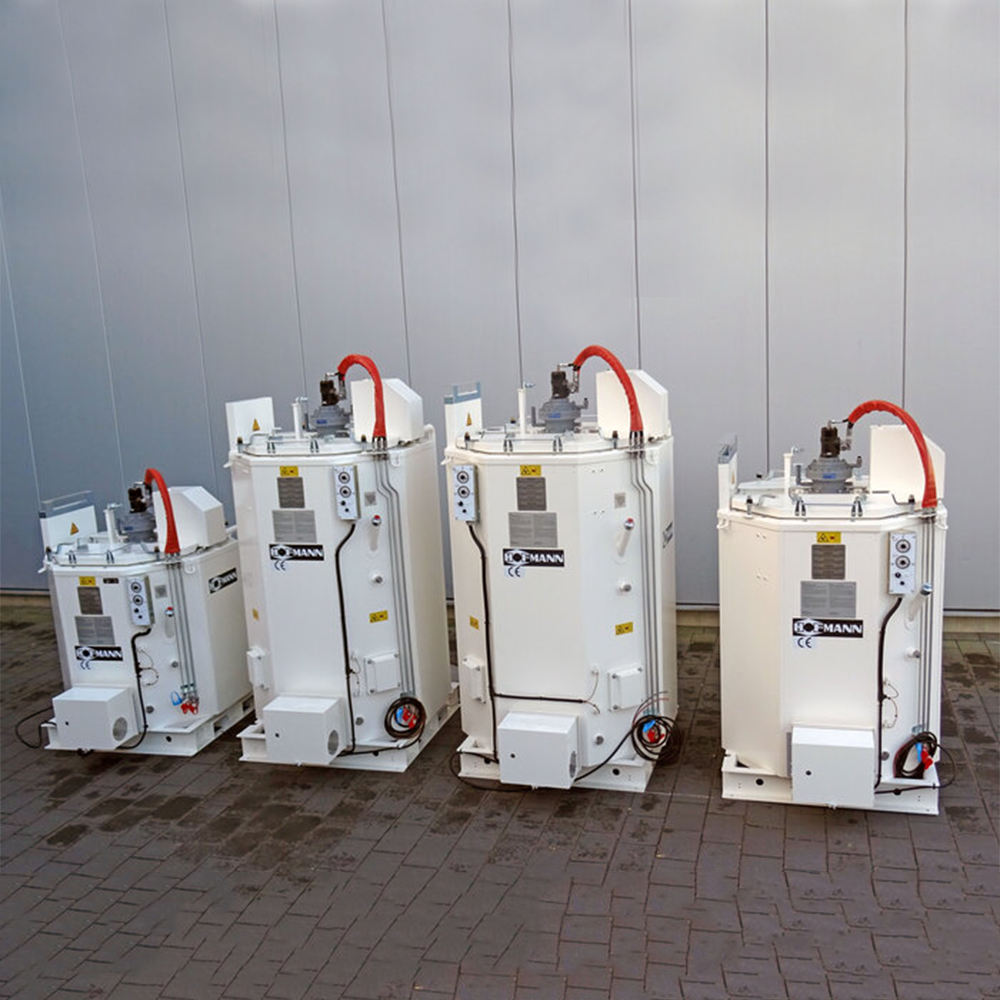
The Hofmann D/ID Series Vertical Cooker is a thermoplastic road marking material melting and holding kettle available in seven models — ID100, ID420-2, ID630-2, ID840-2, ID1100-2, D350, and D520 — covering container volumes from 100 liters to 1,100 liters per unit, with dual-cooker configurations available up to 2,200 liters combined. The ID Series uses indirect heating via thermal oil, while the D Series uses direct heating without thermal oil. All models are heated by gas or diesel oil burners operating at 12V, 24V, or 230V. The hydraulic agitator drive is positioned from above with the agitator shaft supported inside a heated central column — this design means no material-contact seals are present on the agitator shaft, and the shaft can be removed even when the cooker is full of cooled material. Three material outlets are available on the ID840-2 and ID1100-2 models. The enlarged heat transfer surface and the heated central column together maximize heating rate across the full material volume. Hydraulic power unit options are 3.1 kW (approx. 115 kg), 4.6 kW (approx. 233 kg), and 10.0 kW (approx. 380 kg).
The hydraulic agitator delivers high torque for consistent material mixing throughout the melt cycle — critical for thermoplastic compounds that contain glass beads, aggregates, and pigments requiring uniform dispersion before application. The upper assembly dismounts completely for straightforward internal access and cleaning. Optional configurations include an electric agitator drive with battery, an air intake kit for oil burners, a diesel oil burner rated for 100% biodiesel, an electric thermal oil preheating module, right/left rotation switching, and the MTS Material Transfer System for high-throughput material feeding into marking machines. The ID100 variant is a compact, transportable cooker-hydraulic unit integrated into a single assembly, powered exclusively by a 3.1 kW propane gas burner with hydraulic drive.
The Hofmann D/ID Series Vertical Cooker is deployed on road marking projects wherever thermoplastic or spray thermoplastic road marking material must be melted from solid blocks or granules and held at application temperature — including motorway, highway, airport, and urban road marking programs. Units mount on truck flatbeds, trailers, or ground-based platforms, and feed marking machines directly or via the MTS transfer system.
Leader Infra supplies the full D/ID Series vertical cooker range for road marking contractors — covering 100 to 2,200 liters of thermoplastic melting capacity with direct and indirect heating variants, biodiesel-compatible burners, electric agitator options, and complete accessories integration for both thick-layer and spray thermoplastic marking applications.
FAQ — What is the functional difference between the D Series (direct) and ID Series (indirect) heating in thermoplastic cookers? Direct heating (D Series) applies burner heat directly to the cooker vessel wall, making the system simpler and lighter but subject to localized hot spots on the wall that can overheat thermoplastic material in contact with the heated surface. Indirect heating (ID Series) transfers burner heat through thermal oil surrounding the vessel — the oil distributes heat uniformly across the entire inner surface at a controlled temperature, eliminating hot spots and reducing material degradation risk during extended holding periods.




Reviews
There are no reviews yet.